top of page

Traditional Degrees vs Industry-Focused Programs Which Pathway Leads to Career Success

Education shapes the future of every student, but the path to success is no longer one-size-fits-all. The debate between Traditional Degrees vs Industry-Focused Programs has gained momentum as students seek practical skills and job readiness alongside academic knowledge. While traditional degrees provide foundational knowledge, industry-focused programs emphasize employability and hands-on experience. The gap between college education and industry requirements is where most students struggle. This post compares these two educational models to help you decide which path best suits your career goals.
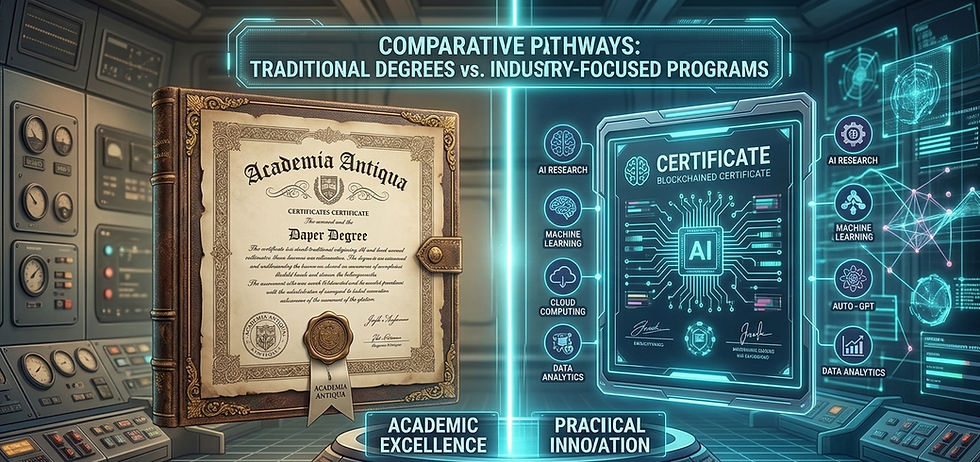

Two certificates compared: a traditional degree and a digital blockchain certificate, highlighting academic versus practical skills in a tech setting.

Curriculum: Theory vs Practical Learning


  • Traditional degrees emphasize a broad theoretical foundation. Students spend years studying core concepts, theories, and principles across various subjects. This approach builds a strong knowledge base but often lacks direct application to current industry needs.


Key differences:


  • Traditional degrees cover extensive theory, sometimes at the expense of practical skills.


  • Traditional programs may include internships, but these are often optional or limited.


  • Industry-focused programs prioritize practical education. Their curriculum is designed around real-world tasks, hands-on projects, and case studies. For example, a software development course might include building apps, debugging, and collaborating on team projects from day one. This method helps students apply knowledge immediately and adapt to evolving technologies.


Key differences:


  • Industry-focused courses focus on job-ready skills and real-world problem solving.


  • Industry programs integrate industry exposure throughout the course.


Skills: General Knowledge vs Job-Ready Abilities


  • Traditional education aims to develop broad intellectual skills such as critical thinking, research, and communication. These skills are valuable but may not directly translate into job-specific competencies.


Examples of skill focus:


  • Traditional degrees: analytical reasoning, theoretical frameworks, academic writing.


  • Industry-focused programs train students in skills demanded by employers. These include technical abilities, software proficiency, teamwork, and project management. For example, a digital marketing industry course might teach SEO tools, content creation, and campaign analytics, preparing students to start work immediately.


Examples of skill focus:


  • Industry programs: coding languages, design software, customer interaction, data analysis.


This focus on job-ready skills helps students bridge the gap between education and employment, especially in fast-changing sectors like IT, design, and business.


Industry Exposure: Limited vs Integrated


  • One major challenge for traditional degrees is limited industry exposure during study. Students often graduate without understanding workplace dynamics or current industry standards. This gap causes many to struggle when entering the job market.

  • Industry-focused programs embed industry exposure into the curriculum. Students work on live projects, interact with professionals, and sometimes complete mandatory internships. This exposure builds confidence and networks, making the transition to employment smoother.

For example, in India, many industry-focused courses partner with companies to offer apprenticeships or project collaborations, giving students firsthand experience.


Career Outcomes: Academic Credentials vs Employability


  • Traditional degrees carry prestige and are widely recognized by employers, especially for roles requiring deep theoretical knowledge or research. However, graduates sometimes face delays in finding relevant jobs due to skill mismatches.

  • Industry-focused programs aim to produce job-ready graduates who can contribute from day one. Employers value these candidates for their practical skills and familiarity with industry tools. This often leads to quicker job placements and career growth.

Consider these points:


  • Traditional degrees may open doors to higher education and research roles.

  • Industry programs often lead to immediate employment in specialized fields.

  • Some sectors still prefer traditional degrees, while others prioritize skills and experience.


Traditional Degrees vs Industry-Focused Programs: Which One Should YOU Choose?


Choosing between a traditional degree and an industry-focused program depends on your career goals, learning style, and the field you want to enter.


  • If you want a broad academic foundation, plan to pursue research, or enter professions like law or academia, a traditional degree may suit you.

  • If your goal is to start working quickly with practical skills in fields like IT, design, marketing, or business, industry-focused programs offer a faster, more targeted path.


In India, where the job market is competitive and evolving rapidly, skill-based education is gaining importance. Industry-focused courses help close the gap between college and industry, making students more employable.


Consider your priorities:


  • Do you prefer learning through hands-on projects or theoretical study?

  • Are you aiming for a specific job role that requires technical skills?

  • How important is immediate employability versus long-term academic growth?


Choosing the right program can shape your career trajectory and future success.


Explore skill-based, future-ready learning with Diorama Eduversity’s industry-ready programs. They offer practical courses designed to equip you with the skills employers want, helping you bridge the gap between education and employment.


Comments


Diorama Eduversity Logo

QUICK NAVIGATION

About

Academics

Students

Parents

GET IN TOUCH

College Address:

Sage University Indore Campus,

Kailod Kartal Indore Bypass Road, Indore, Madhya Pradesh 452020

Head Office:

Diorama Eduversity,

C1, Soami Nagar,

New Delhi 110017,  

Phone: +91-9399574430

info@dioramaeduversity.com

© 2025 by Diorama

bottom of page